Databox Genie AI Review 2026: The End of Manual Data Analysis?
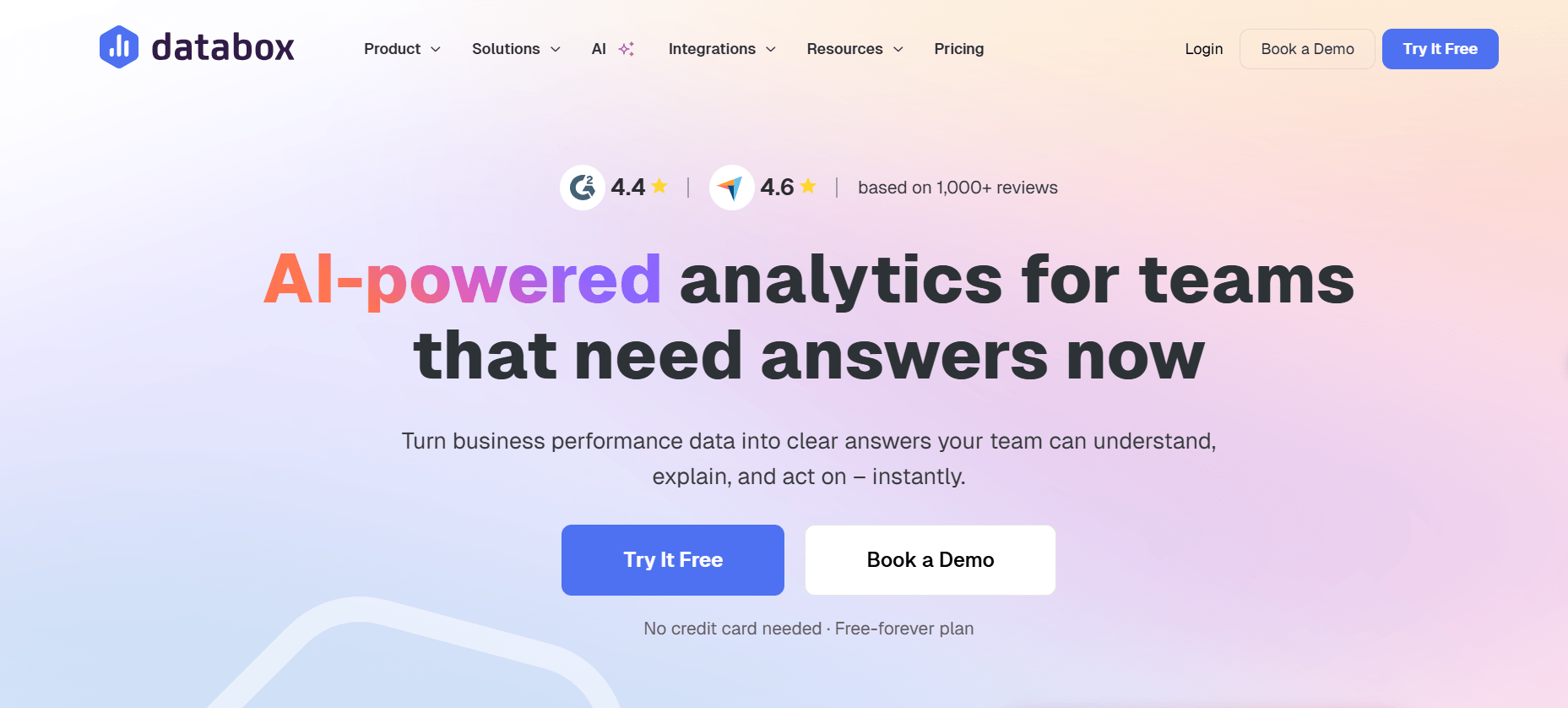
Table of Contents
- Introduction: Moving Beyond "Dashboard Fatigue"
- What is Databox Genie AI? (The Strategic Intelligence Layer)
- The "Blue Ocean" Feature: MCP Integration
- Connecting Your Business Memory to Claude 3.5 and ChatGPT
- Databox vs. The Competition: A Sharp Comparison
- Key Use Cases: From Siloed Data to Correlated Insights
- Case Study: Correlating TikTok Ad Spend with Stripe Churn
- User Experience: The "One-Click" Integration Myth vs. Reality
- Security & Trust: Can You Trust AI with Your Stripe Data?
- The ROI: "Fire Your Data Analyst"
- Final Verdict: Is Databox Genie AI Right for Your Workflow?
- Pros & Cons
- The 2026 Strategic Recommendation
- FAQ: Everything You Need to Know About Databox Genie
Introduction: Moving Beyond "Dashboard Fatigue"
In the fast-paced digital economy of 2026, data is no longer the "new oil"—it is the new noise. For years, founders and marketing teams have been promised that "data-driven decisions" would be their competitive advantage. Yet, most of us find ourselves drowning in what experts now call "Dashboard Fatigue." We have dozens of tabs open—Stripe for revenue, Shopify for sales, Meta and TikTok for ad spend, and HubSpot for CRM—but we are still left staring at flickering charts, wondering, "Why did our churn rate spike on Tuesday?" The gap between having data and actually understanding it has become an expensive chasm.
For the modern entrepreneur, the traditional dashboard is a relic of the past. It’s a filing cabinet in a world that needs a librarian. You don't need more visualizations; you need answers. You need to know if that $5,000 you dropped on a TikTok influencer campaign actually impacted your bottom line three weeks later. Historically, bridging this gap required hiring a junior data analyst or a high-priced consultant to manually correlate spreadsheets. In 2026, that $60,000-a-year entry-level salary is becoming a legacy expense, replaced by autonomous intelligence layers that treat your data as a living, breathing "Business Memory."
Enter Databox Genie AI. This isn't just a facelift for a legacy reporting tool; it is a fundamental shift in how we interact with business information. By moving beyond static pixels on a screen and into the realm of agentic workflows, Databox is positioning itself as the "Strategic Intelligence Layer" for the AI era. It’s designed to solve the "Data Blindness" that plagues even the most successful creators and startups. Instead of you looking for the trend, the trend looks for you. Let’s dive deep into whether this tool is the final nail in the coffin for manual data analysis.
Try Databox TodayWhat is Databox Genie AI? (The Strategic Intelligence Layer)
Databox Genie AI represents the 2026 evolution of business intelligence. While the original Databox was a pioneer in "one-click" dashboarding, Genie AI transforms the platform into an autonomous agent. It no longer waits for you to log in and look at a bar chart. Instead, it monitors your connected data sources 24/7, searching for anomalies, correlations, and growth opportunities that a human eye—or even a standard alert system—would likely miss. It is essentially an "Always-On" analyst that lives inside your tech stack.
The "Genie" aspect of the platform refers to its natural language processing capabilities. In the past, if you wanted to see your "Average Revenue Per User (ARPU) filtered by country and ad source," you had to build a custom query or a complex SQL join. With Genie, you simply ask. Because it is built on the latest LLM architecture, it understands the context of your business. It knows that "revenue" in Stripe and "sales" in Shopify are parts of the same story. This contextual awareness is what elevates it from a mere tool to a Strategic Intelligence Layer.
Furthermore, Genie AI doesn't just report what happened; it attempts to explain why it happened. By utilizing its "Business Memory" core, the AI looks back at historical patterns to provide a narrative. If your conversion rate drops, Genie might cross-reference your site speed data from Google Search Console with your recent deployment logs to tell you exactly which update caused the friction. It’s the difference between a thermometer telling you that you have a fever and a doctor telling you that you have the flu. It is a proactive partner in your business growth.
The "Blue Ocean" Feature: MCP Integration
If you follow the AI space in 2026, you know that the "Model Context Protocol" (MCP) is the biggest breakthrough in agentic workflows. For those unfamiliar, MCP is a standardized way for AI models like Claude 3.5 or ChatGPT to securely access and interact with external data sources without the need for custom, brittle API integrations for every single prompt. Databox has jumped ahead of the curve by becoming one of the first major BI platforms to offer a native MCP server for your business data.
Why is this a "Blue Ocean" feature? Because it solves the "Context Gap" in LLMs. When you use ChatGPT to brainstorm a marketing strategy, the AI is working with general knowledge. It doesn't know your actual profit margins, your real-world customer acquisition costs (CAC), or your current inventory levels. By using the Databox MCP, you are essentially giving your AI assistant a "brain upgrade" that includes your entire business history. You can now prompt Claude with: "Based on my actual Meta spend over the last 30 days and the resulting Stripe revenue, should I double my budget or pivot?" and receive an answer based on hard facts, not hallucinations.
This integration marks the end of "siloed" AI usage. We are moving toward a world where your AI doesn't just write your emails—it manages your P&L. By acting as the secure bridge between your raw data and the world’s most powerful LLMs, Databox makes your business data "portable." You are no longer locked into a specific dashboard interface; your data follows you into whatever AI chat interface you prefer, providing a level of agility that was previously reserved for enterprise companies with dedicated data engineering teams.
Connecting Your Business Memory to Claude 3.5 and ChatGPT
The technical implementation of the Databox MCP is surprisingly elegant. In the 2026 dashboard, users are provided with a secure gateway URL that they can "plug" into their desktop AI clients or custom agent environments. This connection creates a read-only, SOC2-compliant bridge. When you ask a question in Claude about your business performance, the LLM uses the MCP to "call" Databox, which then retrieves the specific metrics required to answer the query. This happens in milliseconds, making the conversation feel fluid and natural.
This "Business Memory" concept is a game-changer for executive decision-making. Imagine sitting in a board meeting and being able to pull up your phone, open your AI of choice, and get a real-time, accurate breakdown of your LTV-to-CAC ratio across four different regions. You don't have to say, "I'll get back to you on that after I talk to the data team." You have the memory of your entire organization at your fingertips. It removes the friction from data retrieval, allowing leaders to focus on strategy rather than searching for the right tab.
Moreover, this integration ensures that your AI interactions are grounded in reality. One of the biggest fears in 2026 is "AI Hallucination"—where an AI confidently gives you a wrong number. By using the Databox MCP, the AI isn't "guessing" what your revenue was; it is reading the calculated value directly from your Databox source. It uses the LLM for reasoning and Databox for the "source of truth." This hybrid approach provides the best of both worlds: human-like communication backed by mathematical precision.
Try Databox TodayDatabox vs. The Competition: A Sharp Comparison
To understand Databox’s value, we have to look at the landscape of 2026. On one end, you have tools like AgencyAnalytics. These are fantastic for marketing agencies that need to produce "pretty" PDF reports for clients. However, they are largely descriptive. They tell you what happened, but they don't have the "Genie" layer to tell you why or the MCP layer to let you talk to the data. If you are a client-facing agency, AgencyAnalytics is great; if you are a growth-oriented founder, it’s often too shallow.
On the other end, you have Looker (by Google). Looker is a powerhouse of enterprise business intelligence, but it has a steep barrier to entry. It requires a deep understanding of SQL and LookML (their proprietary language). For a mid-market startup or a high-volume creator, Looker is "overkill" that requires a full-time hire just to maintain the models. Databox fills the "Goldilocks Zone"—it offers the power of enterprise-level correlation and AI analysis without the need for a computer science degree to set it up.
Then there is Equals.app, which has gained popularity by modernizing the spreadsheet. Equals is brilliant for people who "think in cells." It allows you to pull live data into a spreadsheet environment. However, the fundamental limitation of Equals is that it still requires you to do the work. You have to build the formulas; you have to find the trends. Databox Genie AI flips the script—it does the "thinking" for you, identifying the trends before you even open the app. It’s the difference between a better shovel (Equals) and a self-driving tractor (Databox).
| Feature | Databox Genie | AgencyAnalytics | Looker | Equals.app |
|---|---|---|---|---|
| Core Focus | Autonomous Intelligence | Client Reporting | Enterprise BI | Live Spreadsheets |
| AI Support | Genie (Native) + MCP | Basic Summaries | Vertex AI (Complex) | AI Formula Builder |
| Setup Time | < 15 Minutes | < 30 Minutes | Weeks/Months | 1-2 Hours |
| Technical Skill | Low (English) | Low (Drag-and-Drop) | High (SQL/LookML) | Medium (Excel) |
Key Use Cases: From Siloed Data to Correlated Insights
One of the most profound benefits of the 2026 Databox ecosystem is its ability to break down "Siloed Thinking." In traditional setups, the person running TikTok ads rarely sees the impact on Stripe churn in real-time. These metrics live in different worlds. Databox brings them into a single "Metric Store" where they can interact. This allows for sophisticated use cases that were previously only available to companies with massive data warehouses.
For example, a SaaS founder might use Databox to correlate "Product Usage" (from Mixpanel) with "Subscription Tier" (from Stripe). If the AI notices that users who use a specific feature more than 10 times a week have a 90% lower churn rate, Genie will proactively suggest that you build an onboarding email specifically to drive users toward that feature. This isn't just reporting; it's growth engineering on autopilot. It finds the "hidden levers" in your business that are buried under layers of disconnected apps.
Another powerful use case is "Global Spend Optimization." By connecting every ad platform—Meta, Google, LinkedIn, TikTok, and Amazon—into one view, Databox can calculate your "Blended CAC" across the entire organization. In 2026, where privacy changes have made individual platform tracking less reliable, this holistic view is the only way to truly understand marketing efficiency. Genie can see when your Meta performance is dipping and your TikTok performance is rising, advising you to shift budget in real-time to maximize ROI.
Case Study: Correlating TikTok Ad Spend with Stripe Churn
Consider a hypothetical e-commerce brand, "Lumina Gear," which scaled rapidly using viral TikTok campaigns. For months, their "ROAS" (Return on Ad Spend) looked incredible on the TikTok dashboard. However, their bank account wasn't growing at the same rate. By using Databox to correlate TikTok spend with Stripe data, they discovered a painful truth: the customers coming from TikTok had a 40% higher refund rate than those from organic search.
Without Databox, Lumina Gear would have kept pouring money into TikTok, blinded by the "vanity metrics" of the ad platform. Genie AI flagged the anomaly, noting that while "Top of Funnel" metrics were high, the "Net Revenue" per TikTok customer was actually negative when accounting for shipping and returns. This insight allowed them to adjust their creative strategy to attract higher-quality leads, saving the company an estimated $12,000 per month in wasted spend.
This is the power of a "Business Memory." It doesn't just see the click; it sees the entire lifecycle of the customer. It understands that a "cheap click" is expensive if it leads to a "expensive return." By providing this multi-dimensional view, Databox ensures that you are optimizing for profit, not just for platform-specific numbers that make an ad manager look good but leave the founder broke.
User Experience: The "One-Click" Integration Myth vs. Reality
Marketing for SaaS tools often promises "one-click" setups that turn out to be forty-seven-click nightmares involving API keys, webhooks, and manual field mapping. In the 2026 iteration of Databox, this friction has been significantly reduced, though it’s important to be realistic. For standard integrations like Shopify, Google Ads, and Stripe, it truly is a "Login and Done" experience. Databox has pre-mapped the most common metrics (MRR, Churn, CTR, etc.) so you don't have to.
The real magic in the user experience is the Template Gallery. With over 300+ pre-built "Databoards," you don't have to start with a blank canvas. You can select a template like "The Ultimate SaaS CEO Dashboard" or "E-commerce Growth Tracker," and it will automatically populate with your data. The interface is clean, intuitive, and surprisingly fast, even when pulling in massive datasets from multiple sources. It feels less like an "engineering tool" and more like a high-end consumer app.
However, the "Myth" of one-click comes in when you have highly customized data structures—for example, if you use custom fields in HubSpot to track non-standard metrics. In these cases, you will still need to spend some time in the "Metric Builder." The good news is that the 2026 Metric Builder is guided by an AI assistant. Instead of wrestling with logic gates, you can tell the builder: "I want to track sales of only 'Red' products that were bought by 'Repeat' customers," and the AI will configure the filters for you. It’s not one-click, but it’s definitely "one-conversation."
Security & Trust: Can You Trust AI with Your Stripe Data?
In the age of AI, data privacy is the top concern for every CFO and founder. Giving an AI tool access to your Stripe account or your bank feeds feels like handing over the keys to the castle. Databox addresses this by maintaining rigorous SOC2 Type II compliance and utilizing a "Privacy-First" AI architecture. Unlike some "wrapper" tools that send your data to external models for training, Databox Genie uses your data only for your insights. Your company secrets aren't becoming part of a global training set for the next version of GPT.
Another critical aspect of trust is accuracy. We have all seen AI confidently declare that 2 + 2 = 5. In a business context, that kind of hallucination can lead to catastrophic financial decisions. Databox mitigates this by using the LLM only for the interface and reasoning, while the calculations are performed by their structured data engine. When you ask for your "Monthly Revenue," the AI doesn't do the math—it retrieves the pre-calculated, verified number from the Databox database. This "Deterministic Accuracy" is what makes Genie a professional-grade tool rather than a toy.
Finally, Databox offers granular permission controls. You can decide exactly which "Data Cells" the Genie (and by extension, the MCP) can access. If you want the AI to help with marketing spend but don't want it to have access to employee payroll data, you can toggle those permissions with a single click. This level of control is essential for teams that want to leverage AI without compromising sensitive internal information. It’s "Glass Box" AI—you see exactly what it can see and what it’s doing.
The ROI: "Fire Your Data Analyst"
Let’s talk about the bottom line. A junior data analyst in a major tech hub currently commands a salary between $60,000 and $80,000 per year. Even a part-time consultant can easily cost $2,000 to $5,000 a month. While a human analyst brings intuition and creativity, they are also prone to fatigue, human error, and the need for sleep. They can't monitor your metrics at 3:00 AM on a Sunday, but Databox Genie can.
The ROI of Databox isn't just in the money you save on headcount; it’s in the "Opportunity Cost" of missed insights. How much is it worth to know 24 hours earlier that your Facebook ad budget is being wasted on a broken landing page? For many businesses, that single insight pays for the entire annual subscription of Databox. By democratizing access to high-level analysis, Databox allows small teams to "punch above their weight class," making decisions with the same precision as a Fortune 500 company.
In the 2026 landscape, efficiency is the only way to survive. As AI lowers the barrier to entry for competition, the winners will be those who can iterate the fastest based on the most accurate data. Databox provides that "Iterative Edge." It’s an investment in your company’s "Central Nervous System." If you can replace a $5,000/mo manual process with a $200/mo automated intelligence layer, the math isn't just good—it's transformative.
| Plan | Monthly Cost | Key AI Features | Recommended For |
|---|---|---|---|
| Free | $0 | 3 Data Sources, Basic Genie | Solopreneurs/Testers |
| Starter | ~$47 | Genie Insights, 10 Sources | Growing Startups |
| Professional | ~$135 | Full MCP Access, Advanced Genie | Data-Driven Scaleups |
| Growth/Ent | Custom | Unlimited AI Agents, Priority SOC2 | High-Volume Agencies/Enterprises |
Final Verdict: Is Databox Genie AI Right for Your Workflow?
After a deep analysis of the 2026 business intelligence landscape, it’s clear that Databox has successfully pivoted from a visualization tool to an essential "Agentic Infrastructure" component. If you are a scalable startup, a high-volume content creator, or a marketing agency looking to provide "next-level" insights without increasing headcount, Databox is a non-negotiable part of your stack. The combination of "One-Click" ease and "MCP" power makes it the most versatile tool in its class.
However, it’s not for everyone. If you are a local "mom-and-pop" shop with only one data source (like a single Shopify store) and you already have a good handle on your numbers, the advanced AI features might be overkill. You can probably get by with the free native analytics provided by your platform. Databox is for those who are struggling with complexity—those who have multiple channels, multiple products, and a desperate need to find the signal in the noise. It’s for those who want to stop *managing* data and start *using* it.
Pros & Cons
- Pro: MCP Integration allows you to "talk" to your data via Claude/ChatGPT.
- Pro: Genie AI provides 24/7 autonomous monitoring and anomaly detection.
- Pro: 300+ integrations and templates make setup incredibly fast.
- Pro: Deterministic accuracy ensures no "AI hallucinations" with your revenue.
- Con: Custom metric building still has a slight learning curve for complex data.
- Con: Higher-tier pricing can be steep for very small teams needing advanced features.
The 2026 Strategic Recommendation
My recommendation is simple: If your business generates more than $10,000 in monthly revenue across more than two channels, you should be using Databox. The ability to connect your "Business Memory" to an LLM via the Model Context Protocol is the single greatest productivity hack available to modern leaders. It effectively gives you a $100,000-a-year data analyst for the cost of a few cups of coffee. Don't wait for your competition to start talking to their data—start building your autonomous intelligence layer today.
Try Databox TodayFAQ: Everything You Need to Know About Databox Genie
Does Databox work with Shopify and Stripe?
Yes, Databox has deep, native integrations with both. It can pull everything from "Gross Sales" to "Net Profit after Shipping" and "Customer Lifetime Value" automatically.
What is Databox MCP?
MCP stands for Model Context Protocol. It is a feature that allows you to connect your Databox data directly to AI assistants like Claude 3.5. This lets you ask the AI questions about your real business data in plain English.
Is there a free version of Genie AI?
Databox offers a robust "Free Forever" plan that includes basic Genie AI features. This is perfect for testing the waters and seeing how the platform visualizes your data before committing to a paid plan.
Is my data safe with Databox AI?
Yes. Databox is SOC2 Type II compliant. They use an "Isolated Reasoning" model, meaning your data is used only to answer your specific queries and is never used to train public AI models.

No comments yet. Be the first to share your thoughts!