Mindgrasp AI Review (2026): Is It the Ultimate Weapon Against "Knowledge Debt"?
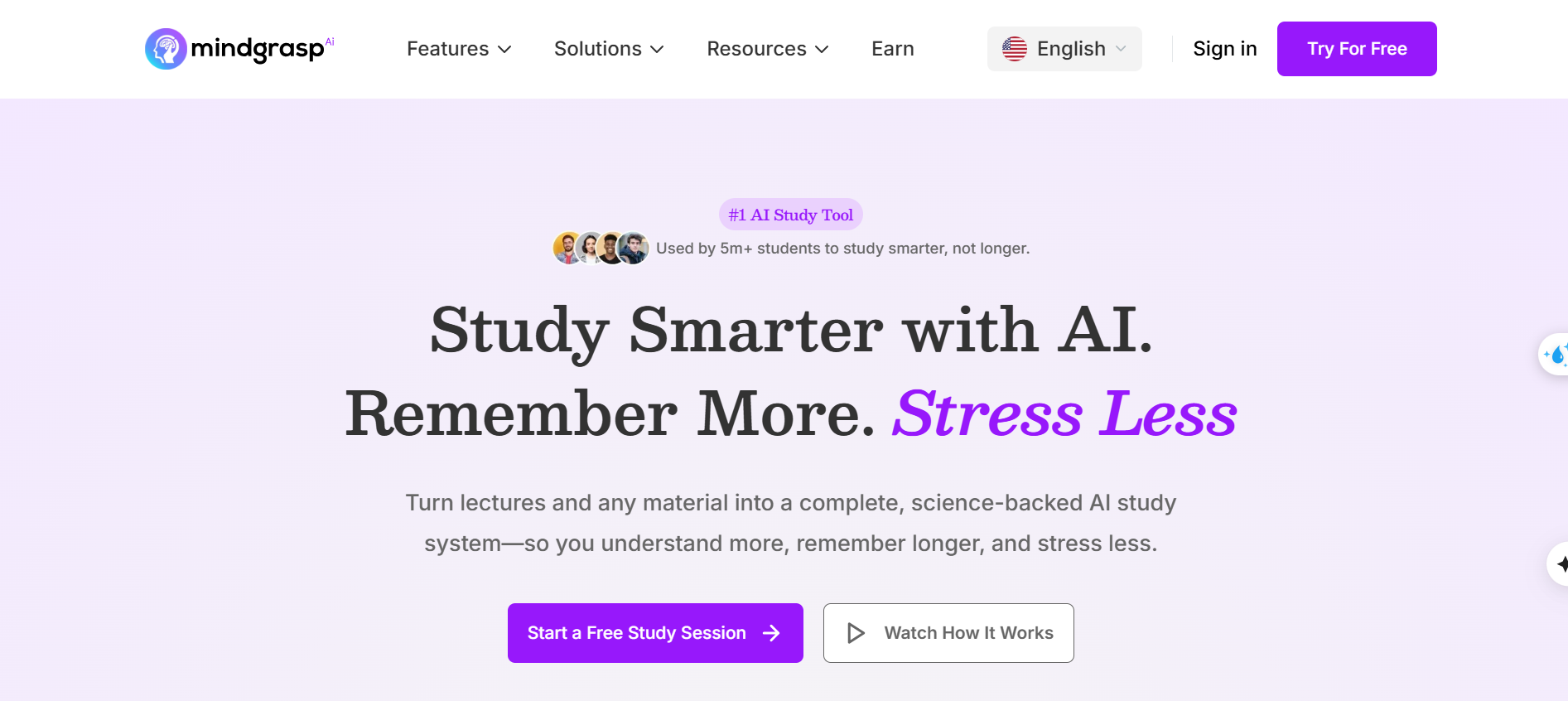
Table of Contents
- Mindgrasp AI Review (2026): Is It the Ultimate Weapon Against "Knowledge Debt"?
- What is Mindgrasp AI? (Beyond the Classroom)
- The Evolution from EdTech to Executive Intelligence
- The Core Problem: Solving the "Cognitive Throughput" Bottleneck
- Key Features: Transforming Passive Consumption into Active Mastery
- Multimodal Pipeline: Video, Audio, and PDF Ingestion
- Source Citations: Auditing the AI to Prevent Technical Hallucinations
- One-Click Knowledge Retention: AI-Generated Quizzes and Flashcards
- Mindgrasp vs. The Competition: A 2026 Reality Check
- Mindgrasp vs. Google NotebookLM: Multimodal Versatility
- Mindgrasp vs. Otter.ai: From Transcription to Pedagogical Frameworks
- Mindgrasp vs. Upword: Why Skimming Isn't Learning
- The Executive Workflow: Integrating Mindgrasp with Your Second Brain
- Exporting to Notion and Obsidian (Markdown Compatibility)
- Synthesizing 10+ Hours of Weekly Podcasts in Minutes
- Mindgrasp AI Pricing: Investment vs. Expense
- The "ROI of Time" Calculation
- Transparency Report: Navigating the Trial-to-Paid Transition
- Pros & Cons
- Pros and Cons: The Architect’s Verdict
- Why Entrepreneurs Love the "Test-Ready" Factor
- Potential Friction Points: Technical Data Nuances
- Final Verdict: Should You Upgrade Your Research Workflow?
- Who is Mindgrasp AI For?
- The Bottom Line: Don't Just Consume Content—Weaponize It.
Mindgrasp AI Review (2026): Is It the Ultimate Weapon Against "Knowledge Debt"?
The universal pain point for global creators and entrepreneurs in 2026 is no longer the access to information, but what we call the "Information-Action Gap." We are drowning in high-value content—YouTube tutorials, five-hour long-form podcasts, and 50-page industry whitepapers—yet most of it sits in a "watch later" graveyard. This accumulation of unprocessed data is "Knowledge Debt," and it is the single greatest bottleneck to professional growth in the digital age.
Enter Mindgrasp AI. While many initially pigeonholed this tool as a sophisticated study aid for students, it has evolved into something far more potent. It is now positioning itself as a high-level executive research engine designed to act as a pre-processor for the human brain. Essentially, it functions as a $1,500/month research assistant available for the price of a Netflix subscription, allowing users to synthesize massive quantities of data into actionable business intelligence in under 60 seconds.
In this comprehensive review, we’ll dive into how Mindgrasp AI bridges the gap between passive consumption and active mastery. We will explore its multimodal capabilities, its competitive edge against giants like Google and Otter, and whether it truly justifies a place in your professional tech stack. If you’ve ever felt the weight of a thousand unread PDFs, this might be the most important software evaluation you read this year.
What is Mindgrasp AI? (Beyond the Classroom)
Mindgrasp AI is a multimodal learning and synthesis platform that uses advanced generative AI to "read," "watch," and "listen" to content on your behalf. Unlike standard transcription tools that merely give you a wall of text, Mindgrasp analyzes the underlying logic of the source material. It identifies key themes, generates structured summaries, and creates interactive learning tools like quizzes and flashcards to ensure the information actually sticks.
For the modern professional, Mindgrasp is a "Second Brain" accelerant. It handles the heavy lifting of initial data ingestion, allowing you to skip the fluff and head straight to the insights. Whether you are an entrepreneur trying to stay ahead of market trends or a researcher managing a library of academic journals, the platform acts as a filter that separates the signal from the noise with surgical precision.
The beauty of the platform lies in its versatility. It doesn't care if your data is a live Zoom meeting, a link to a YouTube video, or a scanned document from 1995. It processes the input and returns a structured output that is ready for implementation. In an era where "time is the only non-renewable resource," Mindgrasp offers a way to buy back hours of your week without sacrificing the depth of your understanding.
The Evolution from EdTech to Executive Intelligence
In its early iterations, Mindgrasp was the "secret weapon" of the Ivy League student, used to breeze through 400-page syllabi. However, as we move through 2026, the tool has undergone a significant brand pivot. The developers realized that the same friction students face—too much reading, too little time—is amplified tenfold in the corporate and entrepreneurial sectors. This realization sparked the move toward "Executive Intelligence," where the focus shifted from passing exams to making high-stakes business decisions.
This evolution is visible in the UI/UX changes and the robustness of the underlying models. The tool now prioritizes professional output formats, such as executive summaries and action-item checklists, over simple study notes. The AI has been fine-tuned to understand business nuances, financial terminology, and strategic frameworks, making it a viable tool for a CEO as much as a college senior.
Furthermore, the integration capabilities have expanded to meet the needs of a professional workflow. By moving beyond a simple "upload and read" interface, Mindgrasp now positions itself as a central hub for knowledge management. It’s no longer just about getting through a lecture; it’s about weaponizing information to gain a competitive edge in a fast-moving market.
The Core Problem: Solving the "Cognitive Throughput" Bottleneck
The "Cognitive Throughput" bottleneck refers to the physical and mental limit on how much new information a human can process and retain in a given day. Most professionals hit this limit by 11:00 AM. Mindgrasp AI solves this by outsourcing the "ingestion" phase of learning. By the time you interact with the content, the AI has already organized it, meaning your brain only needs to focus on the "analysis" and "application" phases.
This shift is transformative for productivity. Instead of spending two hours watching a webinar to find the three minutes of relevant data, you spend thirty seconds reading a Mindgrasp summary and jumping directly to the timestamped source. This effectively triples your cognitive throughput, allowing you to stay briefed on multiple industries or projects simultaneously without burning out.
Ultimately, Mindgrasp addresses the psychological stress of "Information Overload." When you know you have a tool that can instantly deconstruct any piece of media, the anxiety of falling behind disappears. You stop being a passive recipient of information and start being an active curator of knowledge, which is the hallmark of successful leadership in 2026.
Try Mindgrasp AI TodayKey Features: Transforming Passive Consumption into Active Mastery
The standout feature of Mindgrasp AI is its ability to turn "dead" content into a living dialogue. Most AI summarizers provide a static text output that you read once and forget. Mindgrasp, however, creates a dynamic environment where you can ask the document questions, generate test questions to verify your own understanding, and export structured data to your permanent notes. This is the difference between "skimming" and "mastery."
The platform’s architecture is built on a "one-click multimodal pipeline." This means the user experience is frictionless; you don't have to tell the AI how to handle a video versus a PDF. It recognizes the medium and applies the appropriate heuristic to extract the most value. This technical sophistication is hidden behind a clean, intuitive interface that demands almost no learning curve from the user.
Moreover, Mindgrasp includes a robust "Live Capture" feature. This allows users to record live audio—such as a conference keynote or an internal strategy meeting—and see the AI generate notes in real-time. By the time the speaker says "thank you," you have a fully formatted briefing document ready to be shared with your team or integrated into your project management software.
Multimodal Pipeline: Video, Audio, and PDF Ingestion
The hallmark of a premium AI tool in 2026 is its ability to handle "Multimodal" inputs without breaking a sweat. Mindgrasp excels here. You can feed it a YouTube URL, an MP3 of a podcast, a PowerPoint presentation, or a complex PDF research paper. The AI doesn't just transcribe the audio; it "watches" the video to understand visual cues and "reads" the document to understand context and formatting.
For entrepreneurs, this means your "Research" stack is consolidated. You no longer need one tool for transcribing Zoom calls, another for summarizing articles, and a third for extracting data from PDFs. Mindgrasp handles the entire spectrum. This consolidation reduces "tab fatigue" and ensures that all your insights are stored in a consistent format within a single ecosystem.
The speed of this pipeline is equally impressive. Even for hour-long videos or massive documents, the processing time is usually under a minute. This near-instantaneous feedback loop is critical for high-pressure environments where decisions need to be made on the fly based on the latest available data.
Source Citations: Auditing the AI to Prevent Technical Hallucinations
One of the biggest fears for any professional using AI is "hallucination"—the tendency for AI to confidently state incorrect facts. Mindgrasp mitigates this risk through its rigorous Source Citation system. Every note, summary, or answer the AI generates is linked back to the exact page number of a PDF or the specific timestamp of a video or audio file.
This feature is a game-changer for anyone dealing with technical, legal, or financial data. If the AI claims that "Project X will cost $5 million," you can click the citation and instantly see the original source document to verify the context. This "trust but verify" model allows experts to use AI without compromising their professional integrity or accuracy.
By providing a transparent audit trail, Mindgrasp moves from being a "black box" to a reliable collaborator. It encourages a deeper interaction with the source material rather than replacing it entirely. You aren't just taking the AI's word for it; you are using the AI to navigate the source material with superhuman efficiency.
One-Click Knowledge Retention: AI-Generated Quizzes and Flashcards
Reading a summary is great for awareness, but it’s terrible for retention. To truly "own" a concept, you need active recall. Mindgrasp is the only major synthesis tool that automatically generates quizzes and flashcards based on the uploaded content. This feature, originally built for students, has become a favorite for executives who need to master a new industry or technical concept quickly.
Imagine you have a meeting with a new client in the renewable energy sector. You can upload three industry whitepapers to Mindgrasp, generate a 10-question quiz, and test yourself on the key jargon and statistics while you’re in the Uber on the way to the meeting. By the time you arrive, you aren't just briefed; you are "fluent" in the topic.
This pedagogical approach ensures that the time you spend with the tool results in actual brain-state changes. You are moving information from "external storage" (the AI) to "internal storage" (your memory). In a world where everyone is using AI to lazily skim content, those who use Mindgrasp to actually *learn* it will have a massive competitive advantage.
Mindgrasp vs. The Competition: A 2026 Reality Check
The AI market is crowded, but Mindgrasp has carved out a unique niche by focusing on "the gap between ingestion and retention." While competitors like Google's NotebookLM offer powerful research capabilities, they often lack the "active learning" component that Mindgrasp provides. The choice between these tools often comes down to whether you want a digital library or a digital tutor.
When compared to transcription-heavy tools like Otter.ai, Mindgrasp's superiority in synthesis becomes clear. Otter is fantastic for knowing "who said what," but it doesn't tell you "what it means for your business." Mindgrasp takes that raw transcript and applies a layer of strategic intelligence, restructuring the data into a format that is actually useful for decision-making.
Finally, there are the "skimming" tools like Upword. While these are great for high-level summaries of news articles, they often lack the depth required for complex technical or academic work. Mindgrasp’s ability to handle massive, multimodal files with high accuracy makes it the "Pro" choice for those who need more than just a 3-sentence blurb.
Try Mindgrasp AI TodayMindgrasp vs. Google NotebookLM: Multimodal Versatility
Google’s NotebookLM is a formidable competitor, particularly for those deeply embedded in the Google Workspace ecosystem. However, Mindgrasp holds the edge in multimodal versatility. While NotebookLM is primarily document-centric, Mindgrasp's ability to seamlessly ingest live links, YouTube videos, and audio files makes it a more flexible tool for the "modern researcher" who gets their information from diverse sources.
Another key differentiator is the output. NotebookLM is excellent for generating "notebook guides," but Mindgrasp's flashcard and quiz generation is more effective for users who need to perform under pressure without looking at their notes. Mindgrasp feels more like a proactive coach, whereas NotebookLM feels like a very organized filing cabinet.
For users who need to process content from the "wild" (like a random YouTube tutorial or a podcast episode), Mindgrasp is the clear winner. Google’s ecosystem can sometimes feel like a walled garden, whereas Mindgrasp is built to interact with the entire internet as your data source.
Mindgrasp vs. Otter.ai: From Transcription to Pedagogical Frameworks
Otter.ai is the king of the meeting room, but its utility often ends when the meeting does. You’re left with a transcript that is 90% filler. Mindgrasp, on the other hand, is designed to extract the *meaning* from that meeting. It doesn't just record that "John talked about the budget for 10 minutes"; it summarizes the budget constraints, highlights the risks, and creates a quiz to ensure your team understands the new protocols.
This shift from "Transcription" to "Pedagogical Frameworks" is why Mindgrasp is winning over the executive crowd. An executive doesn't have time to read a 40-minute transcript; they need a 4-minute brief with clear action items. Mindgrasp provides the structural hierarchy that raw transcription tools simply cannot match.
Furthermore, Mindgrasp's ability to cross-reference multiple files means you can upload the transcripts from five different meetings and ask, "What are the common objections across all these clients?" Otter.ai struggles with this level of cross-document synthesis, making Mindgrasp the superior choice for high-level intelligence gathering.
Mindgrasp vs. Upword: Why Skimming Isn't Learning
Upword and similar browser-based summarizers are built for speed. They are great for "knowing what’s happening" in the news. However, Mindgrasp is built for *understanding*. The primary weakness of simple summarizers is that they encourage "passive skimming," which leads to an illusion of knowledge. You feel like you know the topic, but you can't explain it five minutes later.
Mindgrasp combats this through its interactive features. By forcing the user to engage with the content—via the AI chat or the generated quizzes—it ensures a much higher level of comprehension. If you are researching a topic that your career depends on, "skimming" is a dangerous strategy. Mindgrasp provides the depth and verification tools that low-end summarizers lack.
In terms of file handling, Mindgrasp is also much more robust. Upword is great for short articles, but if you throw a 150-page technical manual at it, it often loses the thread. Mindgrasp’s architecture is designed for "heavy lifting," making it the reliable choice for serious professional or academic research.
The Executive Workflow: Integrating Mindgrasp with Your Second Brain
The true power of Mindgrasp is realized when it is integrated into a wider "Second Brain" workflow. In 2026, the most productive individuals don't just store information; they build a library of insights. Mindgrasp serves as the "intake valve" for this system, ensuring that only the most valuable, highly structured data makes it into your long-term storage tools like Notion or Obsidian.
The workflow is simple: Ingest raw content (Video/PDF/Audio) via Mindgrasp, let the AI generate the initial summary and key takeaways, and then export that structured Markdown directly into your knowledge management system. This eliminates the "blank page syndrome" of note-taking and ensures your Second Brain is populated with high-quality, cited information rather than messy, unformatted clips.
By automating the formatting and summarization phase, Mindgrasp allows you to spend more time on "connecting the dots." You can focus on how a new piece of information relates to your existing projects, rather than spending hours just trying to remember what the information was in the first place.
Exporting to Notion and Obsidian (Markdown Compatibility)
For the "Productivity Nerd," Markdown compatibility is a non-negotiable feature. Mindgrasp understands this. The platform allows you to export your summaries, notes, and even the Q&A sessions in clean Markdown format. This means you can import them into Notion, Obsidian, or Roam Research, and they will retain their headers, bullet points, and structure perfectly.
This feature solves the "Silo Problem"—the tendency for great insights to get trapped inside a single app. Because Mindgrasp makes it easy to move data out, it becomes a utility rather than a destination. You use it to process the data, and then you move that data to where you actually do your work. This level of interoperability is what separates "toy" AI apps from professional-grade tools.
Moreover, the exported notes include the source citations. This means that even months later, when you are looking at a note in your Obsidian vault, you can see exactly which page of which PDF that insight came from. This builds a permanent, verifiable knowledge base that grows in value over time.
Synthesizing 10+ Hours of Weekly Podcasts in Minutes
We are living in the Golden Age of long-form audio. However, no executive has the 15 hours a week required to listen to every relevant episode of *The Huberman Lab* or *The All-In Podcast*. Mindgrasp allows you to "listen" at scale. By feeding the podcast audio or YouTube link into Mindgrasp, you can get a comprehensive synthesis of the key takeaways, data points, and recommendations in minutes.
This isn't about being lazy; it's about being strategic. You can use the Mindgrasp summary to decide if a particular 3-hour episode is worth your full attention. If the summary reveals a groundbreaking insight in the second hour, you can use the timestamped citation to jump directly to that segment. It’s a "search engine for audio," giving you the ability to scan sound as easily as you scan text.
This approach allows you to stay at the cutting edge of your industry without sacrificing your entire week to passive listening. You can process ten podcasts in the time it would take a competitor to listen to half of one. That is the definition of a competitive advantage in the modern attention economy.
Mindgrasp AI Pricing: Investment vs. Expense
When evaluating the cost of Mindgrasp AI, it’s helpful to view it through the lens of "The ROI of Time." If the tool saves you just two hours of research or note-taking per week, it has already paid for itself several times over, regardless of the tier you choose. In 2026, where high-level freelance researchers charge $50-$100 an hour, Mindgrasp is an absolute steal.
The pricing tiers are structured to scale with your needs. There is typically a "Basic" tier for students or casual users and a "Professional/Executive" tier that offers higher upload limits, faster processing, and advanced export features. For anyone using this tool for business, the Professional tier is the obvious choice, as it removes the friction points that can slow down a high-volume workflow.
One common critique of AI SaaS companies is the "subscription fatigue." However, Mindgrasp justifies its recurring cost by constantly updating its models and adding new features (like the recent 2026 multimodal upgrades). It’s not a static tool; it’s an evolving intelligence that gets better the more you use it.
The "ROI of Time" Calculation
Let's do the math. If you earn $100/hour and Mindgrasp saves you 5 hours of content consumption/synthesis per week, that is $500 of "found time" every single week, or roughly $2,000 a month. Against a subscription price that is a fraction of that, the Return on Investment is several thousand percent. For an entrepreneur, this "found time" can be reinvested into high-leverage activities like sales, strategy, or product development.
Furthermore, there is the "Opportunity Cost" of *not* knowing something. In a fast-moving market, being the first to understand a new regulation or a technical breakthrough can be worth millions. Mindgrasp ensures you are always the best-informed person in the room, which is an intangible benefit that far outweighs the monthly subscription fee.
Ultimately, Mindgrasp should be viewed as a "Business Accelerator" rather than a "Study Tool." When you frame it as an investment in your own cognitive capacity, the price becomes irrelevant. It is an "edge" that you buy every month to ensure you aren't left behind by the sheer volume of global information.
Transparency Report: Navigating the Trial-to-Paid Transition
Market sentiment indicates that some users find the "trial-to-paid" transition in many AI tools to be aggressive. Mindgrasp is no exception to the SaaS industry standard of requiring a credit card for a free trial. Our advice: be proactive. Set a calendar reminder for 24 hours before your trial ends. This isn't a "scam"—it's how the industry operates—but being a savvy consumer means managing your subscriptions actively.
That said, most users who actually *use* the tool during those first four days find it impossible to go back to their old, manual way of working. The "aha" moment usually happens when you upload a complex 50-page document and realize you understand it better in 5 minutes than you would have in 5 hours of manual reading. Once you hit that realization, the subscription becomes a "must-have" rather than a "nice-to-have."
Mindgrasp has also made strides in 2026 to improve their billing dashboard, making it easier to see your usage limits and manage your plan. They are listening to user feedback, and the trend is toward greater transparency and user control, which is a positive sign for the long-term health of the platform.
Pros & Cons
- Pro: Unmatched multimodal ingestion (YouTube, PDF, Audio, Live Capture).
- Pro: "Active Recall" features like AI-generated quizzes and flashcards.
- Pro: Precise source citations to eliminate hallucination risks.
- Pro: Clean Markdown export for Notion/Obsidian users.
- Con: Can be overkill for simple, short-form articles.
- Con: Trial-to-paid transition requires proactive management.
- Con: Occasional struggle with highly decorative or poorly formatted "scanned" PDFs.
Pros and Cons: The Architect’s Verdict
From an architectural standpoint, Mindgrasp AI is a masterpiece of "Information Orchestration." It doesn't just store data; it organizes it into a hierarchy that the human brain can actually use. The "Pros" heavily outweigh the "Cons," especially for power users who deal with high-density information daily. The ability to verify every claim via citations is the "killer feature" that elevates it above 90% of the AI tools on the market.
However, no tool is perfect. The primary "Con" is that Mindgrasp requires a certain level of "Input Quality." If you feed it a low-quality, blurry scan of a handwritten note, the OCR (Optical Character Recognition) may struggle. Similarly, while it is excellent at technical data, it can sometimes miss the "emotional subtext" of a creative piece—though, for business research, this is rarely an issue.
The "Architect's Verdict" is that Mindgrasp is the best-in-class tool for *synthesis*. If your goal is to produce a 500-page novel, use something else. But if your goal is to deconstruct a 500-page manual so you can build a business on top of it, Mindgrasp is your primary weapon.
Why Entrepreneurs Love the "Test-Ready" Factor
Entrepreneurs love the "Test-Ready" factor because it addresses their biggest fear: looking unprepared. In high-stakes environments, "kind of" knowing a topic isn't enough. By using Mindgrasp’s quiz generation, an entrepreneur can "stress-test" their knowledge before a pitch or a board meeting. It provides a level of confidence that simply reading a summary cannot provide.
This feature also makes Mindgrasp a powerful tool for internal training. An entrepreneur can upload their "Standard Operating Procedures" (SOPs) and generate quizzes for new hires. This ensures that the team isn't just "reading the manual" but actually comprehending the company's core processes. It turns Mindgrasp into a decentralized training department.
Ultimately, the "Test-Ready" factor is about *performance*. Entrepreneurs are high-performance individuals, and they need tools that match that energy. Mindgrasp doesn't just give you the answers; it ensures you know the material well enough to answer the questions yourself when the pressure is on.
Potential Friction Points: Technical Data Nuances
While Mindgrasp is incredibly advanced, it can occasionally hit friction points with extremely niche technical nuances—think high-level quantum physics or hyper-specific legal precedents from obscure jurisdictions. In these cases, the AI's summary might be technically correct but miss the "expert-level" implications. This is why the "Source Citation" feature is so critical; it allows the expert to fill in those final 5% of nuances.
Another potential friction point is the "Volume of Output." Sometimes, if you ask for a "comprehensive" summary of a 500-page book, the summary itself can be 20 pages long. Managing that much "summarized" data still requires a bit of human effort. It's important for users to learn how to prompt the AI to give them the specific *type* of summary they need (e.g., "Give me a 5-bullet executive brief" vs. "Give me a deep dive").
Lastly, as with any AI tool, there is a learning curve in "Prompting." To get the absolute best out of Mindgrasp, you need to be specific in your questions. If you ask a vague question, you might get a generic answer. However, for 95% of business and academic use cases, the tool works brilliantly right out of the box with zero specialized knowledge required.
Final Verdict: Should You Upgrade Your Research Workflow?
The short answer is: **Yes.** In 2026, the cost of being "slow to learn" is higher than it has ever been. If you are still manually highlighting PDFs and re-watching 2-hour webinars to find key points, you are operating at a massive disadvantage compared to those using synthesis engines like Mindgrasp AI. It is the literal definition of "working smarter, not harder."
Mindgrasp has successfully bridged the gap between a student study tool and an essential executive asset. Its multimodal flexibility, commitment to accuracy via citations, and focus on active retention make it a unique powerhouse in the AI landscape. It doesn't just save time; it improves the quality of your thinking by freeing your brain from the drudgery of data entry and allow it to focus on high-level strategy.
If you find yourself constantly saying "I'll read that later" or "I wish I had time to watch that," you have a Knowledge Debt problem. Mindgrasp AI is the solution to liquidate that debt and start building a real, actionable knowledge base. Don't let your "watch later" list define your professional ceiling.
Who is Mindgrasp AI For?
Mindgrasp is for the "High-Stakes Learner." This includes entrepreneurs who need to master new markets, executives who need to synthesize team reports, PhD students managing vast bibliographies, and content creators who need to research deep-dive topics without spending weeks in a library. If your success is tied to how quickly you can process and apply new information, Mindgrasp is for you.
It is *not* for someone who just wants to "skip the work" entirely. Mindgrasp is a force multiplier, not a replacement for human thought. It requires a user who is curious, active, and ready to engage with the insights the AI provides. If you are willing to spend 5 minutes with the AI to save 5 hours of manual work, you are the ideal user.
Lastly, it is for the "Organized Professional." Because of its Markdown export and Notion/Obsidian compatibility, it is a dream tool for anyone building a "Second Brain." It fits perfectly into a modern, digital-first workflow, acting as the high-speed gateway for all incoming information.
The Bottom Line: Don't Just Consume Content—Weaponize It.
The difference between the successful and the mediocre in the late 2020s is how they handle the information deluge. Those who simply "consume" content are spectators; those who "weaponize" it are the ones who build, lead, and innovate. Mindgrasp AI is the tool that allows you to make that transition. It turns a passive YouTube video into a set of flashcards you can master in 10 minutes. It turns a boring 50-page PDF into a strategic checklist for your next meeting.
By liquidating your Knowledge Debt, you unlock a level of mental clarity and professional agility that was previously impossible. You stop feeling overwhelmed and start feeling empowered. The "ROI of Time" is real, and the competitive advantage of being the best-informed person in the room is immeasurable.
Our final recommendation: Start with the trial, upload your most "difficult" PDF or longest YouTube tutorial, and see the results for yourself. You won't just see a summary; you'll see a new way of working. It’s time to stop drowning in data and start swimming in insights. Start liquidating your Knowledge Debt today.
Try Mindgrasp AI Today
No comments yet. Be the first to share your thoughts!